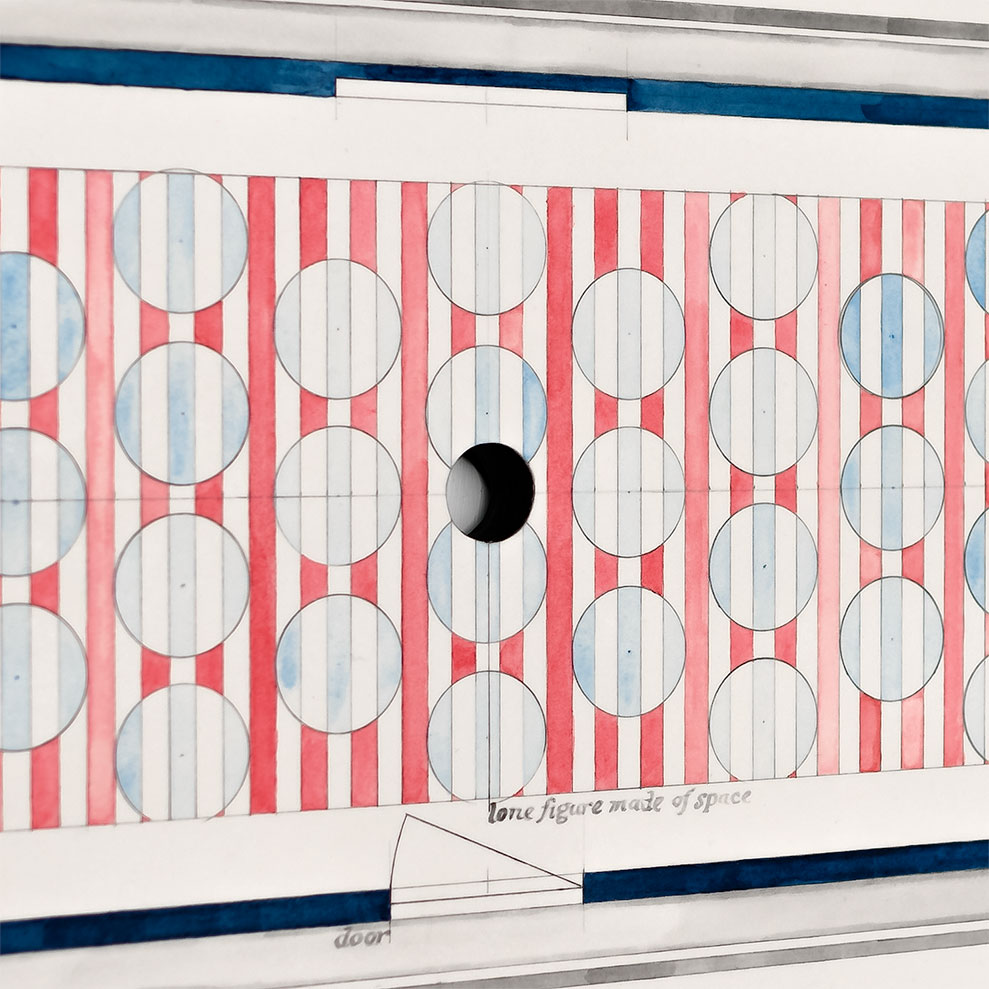

Encyclopaedia of Real Space
She is alone this figure of hollow space known as the outside.
Aether thin, shared as background: being’s realm — she is not alone.
Encyclopaedia of real space: one background, 2023
watercolour and lead pencil on paper, varnish with UVLS on watercolour, acrylic on wood and actual space
29.5 x 118 x 1.8 cm
————————
Encyclopaedia of real space: one background is a self-portrait.
It shifts between a central figure against a ground and the same figure as the ground. Actual space constitutes both figure and ground as one and the same. Yet within this sameness there shifts a movement between one extreme (as figure) and its opposite (as ground).
Since the self-portrait’s figure is me, I am this movement between opposite extremes.
Any psychologist reading this might wonder if I suffer what is called ‘dissociation’. Instead of associating with an image of myself with two eyes, a nose, a mouth and brown hair — an image someone might recognise in the street and to whom they yell ‘hi Gail’ — I associate with the space outside me. Instead of existing in a private enclave of self-certainty I know as me, I exist in an outside movement — through an encyclopaedia of real space.
Dissociation is a chronic and debilitating state those who have suffered abuse might experience. I don’t doubt the condition’s severity.
While I don’t have the grade to argue with any psychologist’s assessment of my self-depiction as dissociated — I do proffer an alternative or parallel understanding.
For instance, we might also consider metamorphosis as the change one undergoes when engaging in cultural exchange. To follow the steps of a character in a novel, for instance, a reader unwittingly transfigures into that character to appreciate the character’s encounters, all the while maintaining a sense of self to which the reader safely returns. The movement in one direction, then retracts in the other.
Where, then, might one draw the line between this ancient realm of metamorphosis and its assessment, today, as dissociation?
The artwork’s text in the Encyclopaedia of real space follows the form of an elegiac couplet in which the ancient poet Ovid was most adept. Enamoured by the couplet’s structure, it seems to me to follow a metamorphic passage in itself.
The couplet’s metre includes a six-foot line followed by a five-foot line in a repetitive long, short, short beat. You can find an avid exploration of Ovid’s elegiac couplets in Literature and History (dot com) that I’ve only somewhat belatedly discovered.
Ovid describes the structure when he writes (as translated):
While six feet rise and five pronounce my clear decline
In elegiacs. Farewell, epic line.
The first line inclines, the second line then declines. The first line begins its movement towards a turning point from which the second line returns. The forward then backward progression is the same metamorphic movement one encounters simply reading or engaging in cultural exchange.
In the Encyclopaedia of real space, the elegiac couplet follows a long-short-short (dactyl) metre for a six-count outward movement followed by a five-count dactyl return with a break, a caesura, in the return’s middle:
—— – – | —— – – | —— – – | —— — | —— – – | —— —
—— – – | —— – – | —— | br | —— – – | —— – – | —— (albeit fudged)
Otherwise characterised as dissociation, Encyclopaedia of real space circumscribes thought’s outward and return movement beyond its biological limit — our skin.
Encyclopaedia of real space: one background is a post-Kantian self-portrait. There aren’t many.
Gail Hastings
12 May 2023
NB: Reference to a psychological assessment concerns conversations with professionals in that field after a bike accident I suffered at the beginning of the year. Whiling away minutes describing my work, its importance and how it works instead of describing me, I met the thorny issue of dissociation. It was a shock to realise my work fits that pattern.
