Tag: Donald Judd

  • Space with a phoneme of its own

    Space with a phoneme of its own

    When someone a couple of years back asked what sort of art I make, I hesitated. Easy to answer if one makes either painting or sculpture; difficult, if one makes neither. Worse, still, if one makes a spatial art that is not ‘installation’. For which reason I asked, in response, ‘Do you know of installation’? ‘Yes’, she replied. ‘Well—I don’t make that’.

    Before I could continue, I was asked if I am Irish. Thinking she had politely changed the subject, I tried as best I could to describe my ancestry. ‘Figures’, she said. ‘It is a bit like asking Paddy:
    “Hey Paddy, can you tell me where the nearest pub might be?”
    “Ai, my friend, do you know where McCleery Street is?”
    “Yes Paddy.”
    “Do you know where it intersects McAuley Street?”
    “Yes indeed, Paddy.”
    “Well, it isn’t there”.’

    Point taken. In other words, why point to a positive attribute—a ‘this thing here’—only to say one’s art is not that. Having done so reveals the extent I am desensitised to the non-sense that defines the art I practice; a glitch or necessary blind spot, nevertheless, under which to labour. For invariably, to discuss the art, one has to drive to ‘neither-nor’ places to enable a glimpse of that which contemporary commentary is bereft.

    When, in a survey article published in 1965, the artist Donald Judd wrote ‘Half or more of the best new work in the last few years has been neither painting nor sculpture’, ((Donald Judd, ‘Specific Objects’ (1965) in Complete Writings 1959-1975: Gallery Reviews, Book Reviews, Articles, Letters to the Editor, Reports, Statements, Complaints, Halifax, Nova Scotia New York Press of Nova Scotia College of Art and Design, New York University Press 1975, p. 181.)) little could he image that forty-five years later we would still be stuttering his ‘neither-nor’ description, with no advance on a positive identification. Aiding and abetting such stagnancy, it would seem, is a conflation of ‘neither-nor’ with the Proun Space (an ‘interchange station between painting and architecture’) of Russian artist El Lissitzky (1890-1941), to result in an understanding that turns neither-nor into a nowhere land ‘between painting and sculpture’; an understanding that in fact excludes the space upon which both Donald Judd and, one might argue, El Lissitzky focussed.

    What is Proun Space? The word ‘Proun’ is an acronym of a Russian phrase comprising three words. The first three letters and the first letter of the remaining two words spell ‘Proun’. ((El Lissitzky, ‘Life, Letters, Text’, ed. Sophie Lissitzky-Küppers, Thames and Hudson, London, 1967, p. 401, fn. 7.)) The phrase, when translated, means ‘Project for affirmation of the new’. Yet, after Herbert Read mentions this in his introduction to El Lissitzky’s letters, he tells us,

    ‘But there was never anything essentially new in Lissitzky’s style: it was a synthesis of elements taken directly from the ‘suprematism’ and from the ‘constructivism’ of Malevich, Tatlin and other Russian artists’. ((ibid., p. 7. Note, Herbert Read translates Proun as ‘project for the establishment of a new art’.))

    Many commentators, since, abide Herbert Read’s discernment and overlook El Lissitzky to go directly to the named sources of the ‘new’ (Malevich, et al.). In so doing, they overlook a type of space that remains without a phoneme of its own in our contemporary art lexicon and thereby remains ‘new’, today.

    Not so, however, with Sophie Küppers who, at the time, recognised something very different in the Proun compositions El Lissitzky had been making since 1919. Fascinated upon seeing them the first time at the Exhibition of Russian Art in Berlin in 1922, Sophie obtained El Lissitzky’s address from the Exhibition’s office in hope of exhibiting this ‘new art’ at the gallery she ran, the Kestner-Gesellschaft, in Hanover. ((ibid., p. 11.)) The two met later that year in Hanover, the exhibition took place in 1923 and the two married in January 1925. ((Eric Dluhosch, ‘Translator’s Intorduction’, in ‘El Lissitzky: Russia – An Architecture for World Revolution’, MIT Press, Cambridge, Massachusetts, 1989, p. 15.)) For Sophie Lissitzky-Küppers, El Lissitzky’s Proun compositions were ‘a cosmic space, in which floating geometric forms were held counterpoised by tremendous tensile forces. They were three-dimensional, in contrast to the suprematist compositions of [K]asimir Malevich which gave an effect of absolute flatness and fragmentation’. ((El Lissitzky, ‘Life, Letters, Text’, ed. Sophie Lissitzky-Küppers, Thames and Hudson, London, 1967, p. 11.))

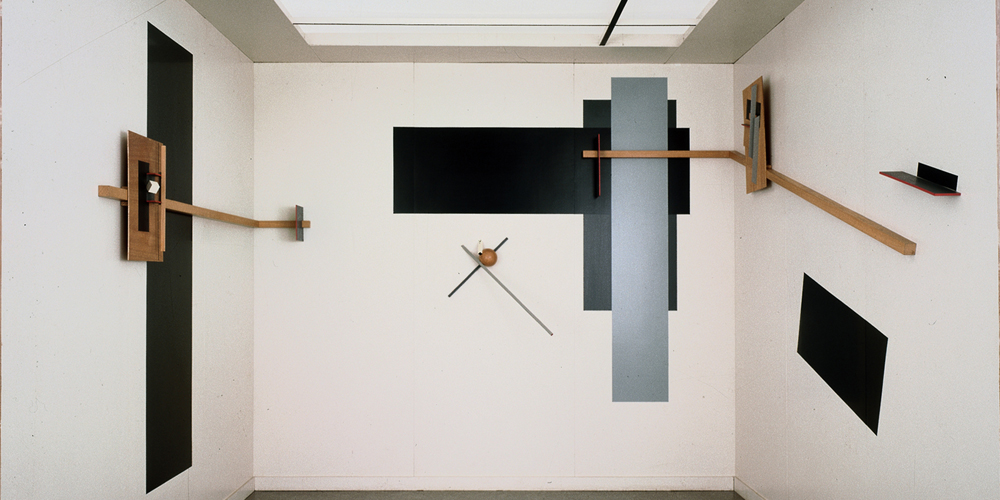
    It is largely this difference, recognised by Küppers, that came to the fore in El Lissitzky’s Prounenraum made for the Great Berlin Art Exhibition of 1923, at the Lehrter Bahnhof (1871) where, today, the Berlin Hauptbahnhof (2006) stands. Given a boxlike space at his disposal, El Lissitzky utilised the intended ‘six surfaces’ (four walls, ceiling and floor), except the floor. ((El Lissitzky, ‘Russia – An Architecture for World Revolution’, tr. Eric Dluhosch, MIT Press, Cambridge, Massachusetts, 1989, p. 139)) Black, white and grey geometric elements stacked either flat on the wall, in relief as wooden assemblages, or protruding as perpendicular wooden slats (‘with a flash of red’), organise the space ‘in such a way as to impel everyone automatically to perambulate in it’. ((ibid.))

    Where, in the earlier Proun compositions, clusters of geometric forms generated a vanishing point contradicting that of the cluster immediately alongside due to separate axes; in the Prounenraum of 1923, the perambulating person moving through it enacts this multi-perspectival viewpoint within a similarly singular space. From right to left,

    ‘the surface of the Proun ceases to be a picture and turns into a structure round which we must circle, looking at it from all sides, peering down from above, investigating from below. … Circling around it, we screw ourselves into the space’. ((El Lissitzky, ‘Life, Letters, Text’, ed. Sophie Lissitzky-Küppers, Thames and Hudson, London, 1967, p. 347. It occurs to me that El Lissitzky, quite possibly, had one follow the room from right to left in the manner Hebrew is read, much in the same way gallery spaces in English speaking countries often organise their space from left to right.))

    Opposing perspectives seen from above and from below install a movement between extremes realised, here, to make space a ‘plastic form’. ((ibid., p. 347.)) In this way, a Proun space might occur through: a cube (on the left Prounenraum wall) in opposition to a sphere (on the wall preceding it); ((El Lissitzky, ‘Russia – An Architecture for World Revolution’, tr. Eric Dluhosch, MIT Press, Cambridge, Massachusetts, 1989, p. 139)) no perspective in opposition to perspective; two-dimensionality in opposition to three-dimensionality; or painting in opposition to architecture; all within one space—to create that space.

    Central to an evaluation by Claire Bishop of El Lissitzky’s Prounenraum with respect to ‘Installation Art’, is its perambulatory nature said to anticipate ‘Merleau-Ponty’s account of embodied vision’. ((Claire Bishop, ‘Installation Art’, Routledge, New York, 2005, p. 80.)) Many regard Phenomenology of Perception (1945) by the philosopher Maurice Merleau-Ponty (1908-61) as key to so-called Minimal art. ((Hal Foster, Rosalind Krauss, Yve-Alain Bois, and Benjamin H. D. Buchloh, ‘Art since 1900’, Thames and Hudson, New York, 2004, p. 494.)) Accordingly, it is perceived Merleau-Ponty, ‘against Descartes’ and any ‘form of idealism’, grounded our being in ‘the partial nature of visual experience due to the “perspectival” limits of human perception’. ((ibid., p. 495.)) The ‘relativism’ of this mono-perspectival ‘embodiment’ is now a general riff that plays through contemporary art history. ((While some may not only disagree with this summation of Maurice Merleau-Ponty’s philosophy but disagree, as well, with whether his philosophy influenced Minimal art, I have taken this understanding from ‘Art since 1900’ given its increasingly prominent use as a resource for a general understanding in contemporary art history.))

    Nevertheless, the evaluation by Claire Bishop appears at odds with the fact El Lissitzky’s Proun Space in not mono-perspectival, but multi-perspectival. It is in the act of going beyond the limits of human perception as a singular-point perspective that constructs a multi-perspectival Proun space. In defiance of relativism, it is our conceptual movement beyond ourselves that enables an embodiment in which we ‘screw ourselves in’. In 1966, Joost Baljeu asks, ‘What does a Proun express? Infinite space? Emptiness?’, by way of reply he quotes El Lissitzky:

    ‘The energetic task which art must accomplish is to transmute the emptiness into space, that is into something which our minds can grasp as an organised unity’. ((Joost Baljeu, ‘The new space in the painting of El Lissitzky’, in El Lissitzky, ‘Life, Letters, Text’, ed. Sophie Lissitzky-Küppers, Thames and Hudson, London, 1967, p. 390.))

    While in 1924, in a magazine compiled with Hans Arp called ‘The Isms of Art’, El Lissitzky defines Proun as ‘the station for change from painting to architecture’, in 1925 he writes ‘I cannot define absolutely what “Proun” is’. Sophie Lissitzky, however, refers to a 1928 definition, ‘the interchange station between painting and architecture’, generally quoted since. ((El Lissitzky, ‘Life, Letters, Text’, ed. Sophie Lissitzky-Küppers, Thames and Hudson, London, 1967, p. 21. Sophie Lissitzky-Küppers appears to quote from a ‘personal confession’ entitled ‘Lissitzky Speaks’ (p. 330) and not, as some seem to think, from a statement written to her in a letter.)) Rather than treat this interchange station as a location neither here nor there, a destination not yet reached after a departure some time ago, Joost Baljeu instead interprets it as ‘the station at which art changed trains for architecture’, wherein art became a ‘construction of space’. ((Joost Baljeu, ‘The new space in the painting of El Lissitzky’, in El Lissitzky, ‘Life, Letters, Text’, ed. Sophie Lissitzky-Küppers, Thames and Hudson, London, 1967, p. 392.)) After all, this literally took place at the Lehrter Bahnhof: not a nowhere station ‘in-between’ but at the end of the Lehrte-Berlin line—a definitive location.

    In emphasising this, it is not to say a spatial construction excludes either painting or sculpture. Rather, if we focus on ‘spatial construction’ instead of slotting this art ‘between painting and sculpture’, we might finally find the positive terms with which to describe spatial art, rather than let it remain within the silence of an ‘in-between’ land that is ‘neither-nor’.
  • Thank goodness Donald Judd wasn’t a misogynist

    Thank goodness Donald Judd wasn’t a misogynist

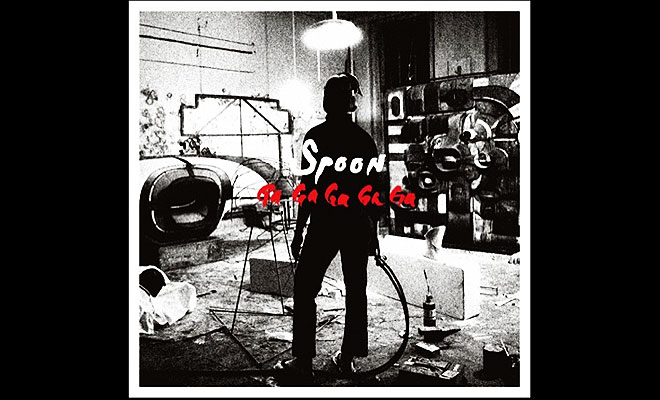
    While browsing iTunes one fine July 2007 day, I happened upon a new release by Austin Indie band ‘Spoon’ with a cover image of the artist Lee Bontecou by photographer Ugo Mulas, taken in 1963.

    Instantly impressed, I eagerly investigated further and came across an interview. Here, singer/guitarist Britt Daniel explains that, although he was not aware of the sculptor before coming across the image, the image immediately struck him as typifying the mood he felt about the record. ‘It’s just this guy, Bontecou, looking at all these pieces of debris’ says the interviewer, to which the singer replies, ‘Yeah, and they’re weird pieces. Or colorful. They just are’.

    While I suggest the singer had his band’s songs more in view than Lee Bontecou’s art by his reply (as Lee Bontecou’s art, of that time, was pretty much dark and light with a lot of dirty looking tones between), what is nevertheless startling is that, rather than inform the interviewer Lee Bontecou is female, the singer instead revealed he, too, thought Lee Bontecou is male; for which reason, it now becomes obvious, he felt an affinity.

    The mistake would have been mortifying for the singer once discovered, which it was, as made evident by another interview some weeks later. Had he realised earlier, the impetus behind the cover’s selection would not have been there and another image would have appeared in its place. So I am glad of the mistake, as it has produced one of the most arresting album covers I have seen in a long time.

    Although these mistakes are everyday and unworthy of being held ransom to, this one is nevertheless uncanny since it bespeaks a silent tragedy that has throttled a vital understanding of contemporary art from around the time the photo was taken up until today. For what this mistake reveals—given the singer most likely comes from a progressive background—is that even under such an enlightened perspective, an innate prejudice still persists in society to the extent certain postures are read as male, only. The blowtorch, a back turned rather than a front offered, independence of mind, an absorption in one’s work, a disdain for conformity, taking one’s time and our gaze directed in a non-objectifying way spell male artist, not female. If this is now, no wonder Lee Bontecou’s art was treated as threatening in New York’s decidedly male dominated art scene of the late 1950s—back then.

    For these reasons, Lee Bontecou’s art could have easily been dismissed by the minimalist artist Donald Judd who was on the job, at the time, as an art writer as a means to fund his then relatively unknown studio practice. If the catalogue essay for the present exhibition Less is More is right in its description—where, ‘for him, less (or non) of some things—symbol, narrative, illusion, incident—meant more of an emphasis on others—like dimensionality, shape, ‘material as material’ and an engagement with real space’—then Donald Judd’s dismissal of Lee Bontecou’s art should have been par for the course. But, it wasn’t.

    Instead, Donald Judd recognised in Lee Bontecou’s art a paradigm shift. Even the term most associated with Donald Judd—‘specific objects’—was first formulated, as the art historian Richard Shiff points out, in 1963 when describing a Lee Bontecou relief as ‘actual and specific and … experienced as an object’. (GH, The process of specific space, 2009.)

    According to the New York Times art critic Roberta Smith, Specific Objects is one of the three most significant contemporary art essays to this day (ref). The other two are Clement Greenberg’s Modernist Painting (1960-1) and Michael Fried’s Art and Objecthood (1967). It was written in 1964 when Donald Judd was assigned to write a survey article of the present art situation, yet was not published until the end of 1965. Its opening sentence is now iconic: ‘Half or more of the best new work is the last few years has been neither painting nor sculpture’. (ref.) Written afterwards, though published months before, is another text by Donald Judd that opens: ‘Lee Bontecou was one of the first to use a three-dimensional form that was neither painting nor sculpture’. (ref.)

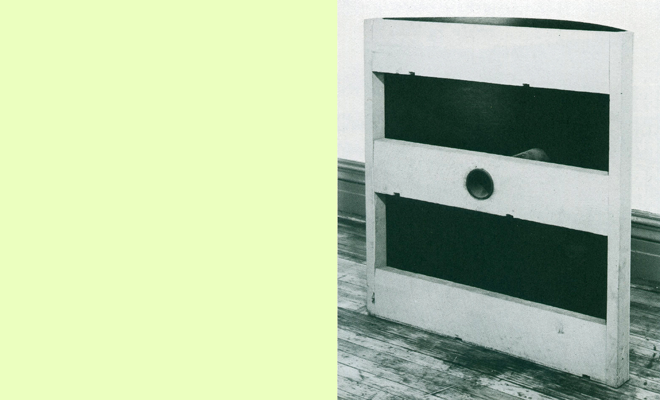
    In these works by Lee Bontecou of that time (see Slide 4 above), we see an eruptive force explode a gridded picture plane into the actual space of the room. ‘Bontecou’s constructions stand out from the wall like contoured volcanoes. Their craters are voids but exceedingly aggressive ones, thrust starkly at the onlooker; these are threateningly concrete holes to be among’, wrote Donald Judd in 1960. The resulting radiation of concentric circles intrude upon the usually segregated space of a viewer, with a black gaping hole at the centre.

    ‘The black hole does not allude to a black hole; it is one’, wrote Donald Judd in 1965. Posited, then, at the centre of a pictorial space was a black hole of real space. In being real, the usual segregation between the pictorial space of a work of art and the real space of a room in which we look at that work of art, had been violated. As a result, the artwork’s black hole moves between opposing poles as a space that includes us (real space) and a space that excludes us (pictorial space).

    Upon observing this dialectical action of space, Donald Judd took it back to his studio as a tool that helped redefine his art into the art we recognise as his, today. He later describes it as created space. It is an active space opposite to the space we have come to know through the writing of Robert Morris, which is a passive space—such as the given space of a room. The difference between the two may be difficult to comprehend, especially as Donald Judd is broadly known as laying heavy emphasis on the ‘given’ — on ‘material fact’— which would lead one to think the space of his art is the same room space as Robert Morris’, but it is not. Real space, for Donald Judd is not found as is the space of a room, but created.

    To understand this difference we have to remember Donald Judd majored in philosophy at Columbia University. Much in philosophy focuses on the question of truth, such as: how do we know the representation of an object in our thoughts corresponds with the actual object outside our thoughts. In other words: how do we know we are not just imagining it? Post-modernism’s reply is that we cannot know, since everything is relative: what I see from my perspective will be different to what you see from your perspective.

    If we are locked into our own perspective, then it is easy to be held captive by our own prejudice. We see an example of this in America’s political far right, who insist President Obama has no legitimacy to be President since he was not born in America; a belief they hold onto even though the White House has released the President’s birth certificate (the fact of the matter) that proves otherwise. Relativity, therefore, knows no bounds; facts don’t figure.

    You can see why Donald Judd would not have championed post-modernism and its accompanying relativism, given he was on the side of facts. What this means is that, rather than start from a position of self-certainty, barricaded in by one’s own perspective, one instead starts from a space of uncertainty, moves beyond it, takes up the space of the other (facts), from which one then returns with knowledge of the other. As Richard Shiff has said, ‘Judd was more of a viewer than most viewers are … [he] recognised the danger of starting his position as definitive’ (ref). Instead of a perspective without bounds, facts—the other—holds it in check. In philosophy it is known as intersubjectivity. It is the opposite of relativism.

    When Donald Judd observed a dialectical act of space in Lee Bontecou’s art, he recognised in it the dialectical act of intersubjectivity. Thought, then, that creates this dialectical act of space does not take place in the private space of oneself, but the public space outside oneself: the space of the other, of ‘facts’ — the artwork.

    As I have written earlier:

    Robert Storr, when recently writing on Lee Bontecou who ‘dropped out of the art world at the height of her fame in the mid-1970s’, points out that, ‘Writing someone back into art history thus entails risks both for the writer and the artist’. Critically unmeasured advocacy, or ‘sins of commission’, can cause more damage than past writers’ ‘sins of omission’.

    Without refrain, nevertheless, Robert Storr little flinches when pointing out one drastic omission in particular, that of Lee Bontecou’s work by Rosalind Krauss in Passages of Modern Sculpture (1977); a book that ‘established the canon for many curators and critics with power in or over major institutions’. Drastic, in that, to ‘be left out of the book meant oblivion in many academic circles where histories are constructed’.

    Mentioned are just five women sculptors: Louise Bourgeois, Barbara Hepworth, Eva Hesse, Louise Nevelson and Beverley Pepper. ‘None except Hepworth and Pepper rate more than a line or two and a text figure’.

    With this he points out, ‘Robert Morris, the sculptor-critic of the 1960s to whom Krauss’s work is heavily indebted, did not discuss Bontecou in his Continuous Project Altered Daily’; added to which, ‘Krauss’s other mentor Clement Greenberg did so once, only in passing and disparagingly at that’ (ref).

    In a footnote Robert Storr adds:

    I have emphasized Judd’s role in critical literature on Bontecou in part because his ability to recognize and eagerness to champion her work are key to understanding his position. Judd’s … tough-minded thinking … never takes the fatal step into prescriptive or proscriptive dogma commonly taken by other formalists of the period. Like Lippard, Judd was a writer of strict standards, and was open to arguments that diverged from the perspectives he primarily adopted. Although opinionated, he was an aesthetic empiricist and a pluralist. Moreover he was alert to artists work outside the mainstream, and seemingly at odds with the classicism of his own approach, as if these artists spoke for the eccentric or grotesque parts of his own sensibility that he had subordinated to his formally severe methods and means. (ref)

    In accrediting Donald Judd for championing Lee Bontecou’s art, we also see Robert Storr flounder a bit in trying to understanding why he did so, to end up suggesting Lee Bontecou’s art may have spoken for a subordinated part of his own, when nothing of the sort is the case. Yet, to suggest this indicates Robert Storr is not familiar with the type of space of Donald Judd’s art, nor the role of Lee Bontecou’s art in its genesis. This is not surprising for the reasons he himself has revealed, in which we see the effect of an invisible misogyny determining an art historical account even in modern times.

    This is also apparent in James Meyer’s books on minimalism in which the space of Donald Judd’s art always comes off as a poor man’s Robert Morris, since Robert Morris’ is the only understanding of space the writer acknowledges. Within its context Donald Judd’s art is judged both badly and mistakenly.

    The Less is More catalogue follows this pattern and, by doing so, reenacts an inherited misogyny. As a result, Donald Judd’s main concern is left out: created space.

    Minus its proper nomenclature (‘created space’) and minus recognition of its genesis, this is the space to which I was introduced as minimalism when an art student in the late eighties at the VCA, Melbourne. Sitting in the dark of a slide show, with an art history teacher decrying again and again ‘but don’t you see’ while projecting an image of a Donald Judd piece (see Slide 5 above), I have to admit at first I didn’t. No matter the times he described the work in terms not unlike those I’ve used to describe Donald Judd’s observations of Lee Bontecou’s art, and no matter how beseeching his ‘but don’t you sees’ became—I just didn’t. All I could see was a grainy black and white photo of a number of fabricated metal boxes lined up in a row, industrial looking, hard, uninviting, purposively made yet seemingly pointless—with another row mounted on the wall behind. None of this seemed ‘new’ nor exciting, let alone anything to do with ‘space’. Once you’ve seen a metal box you’ve seen a metal box, what more is there to see?

    A little shocked by my negativity, I finally decided to notice something I had been staring at but avoiding to see because it seemed so pointless: a black hole opening at the end of a rectangular tube inset horizontally along the top front edges of the boxes, joining them. In finally seeing this comparatively small black hole, it drew my imagination beyond the prejudice that had previously held me back. My thoughts now zoomed along the narrow tunnel’s darkness, aware of the blackness’ constricted space, length, openness and frictionless speed. Then suddenly, I was jettisoned into its opposite: the internal comparatively vast blackness of the first metal box that was closed, contained, motionless and in which I felt stuck.

    Shocked, my eyes focused on the box’s metal exterior that now gained a hitherto unthought-of thinness that gave me surprising comfort, in an effort to hoist my thoughts out of the box’s dark insides and back into the light. Safe again, my focus gravitated to the shadowed gap between the first and second boxes that took on a robust thickness compared with the metal thinness sandwiching it on two sides. With this, I finally understood my art history teacher’s exhortations to see our conscious thoughts taking place in this space outside us, rather than in the dark of our physical self (he was, admittedly, German and no doubt brought up on the philosophy that allowed him to draw our attention to this).

    Then the slide projector revved into motion as the next slide lunged into view, when I had only begun to see the previous one. How did Donald Judd orchestrate all this space intact with intricate differences that seemingly exploded from nowhere? How was it possible not at first to see what was now so abundantly present, when before all I could see was a row of metal boxes? And how were my thoughts taking place out there, amidst all that, rather than locked away in the privacy of me?

    From that day on I have been dedicated to minimalism. While I admit I have, at times, been lazy in my observations and have sometimes been swayed by criticisms before recognising their fallacies, I have never lost sight of how minimalism makes fundamental experience a self-consciousness of our freedom.

    The piece by Donald Judd described above, Untitled 1966, was exhibited in the exhibition Primary Structures at the Jewish Museum, New York, in April 1996. In the catalogue for the exhibition, Donald Judd writes:

    ‘I object to several popular ideas. I don’t think anyone’s work is reductive. The most the term can mean is that new work doesn’t have what the old work had. … New work is just as complex and developed as old work. … Prior work could be called reductive too; … compared to the new work it would even mean less, since then much of its own meaning would be irrelevant’. (ref)

    The point here is that every period of art throughout history is ‘reductive’ since it includes less of the period preceding it, to make way for what is new. Use of the term to differentiate one period from another is therefore redundant. Moreover, as one can see by the description of space above, this art involves extraordinary complexity, not reduction. As long as one continues to call it ‘reductive’ one continues to negate its complexity and thereby negate what is truly new.

    To move beyond a ‘reductive’ understanding of minimalism, I suggest you start with Donald Judd’s piece included in Less is More. First, free yourself of the limitations with which you might at first perceive it (it’s just a well crafted metal box, open on two ends with coloured perspex inside that sits on the floor and around which I can walk), by finding what you keep staring at but, because of these limitations, keep refusing to see. Then hold on to your hat as you get drawn into an architectonics of space at the very moment of being made, where ‘physics and fantasy are indivisible within an impossible spatial möbius’.(ref)

    In the end, you might also find yourself thankful Donald Judd did not dismiss the importance of Lee Bontecou’s art when most did. Thankfully, there is an increasing number of art historians who seek facts over hearsay and who have, as a result, rescued the created space of Donald Judd’s art from the oblivion of misogyny’s tragic graveyard. Foremost, of course, is Richard Shiff, as well as David Raskin, including curators who worked with Donald Judd, Marianne Stockebrand.

    As an appropriate ending, then, it is worth having a listen to one of Spoon’s more popular tracks on this 2007 album with Lee Bontecou in her studio on its cover. For uncannily, although the selection of this image was the result of mistaken identity, the track suggests no mistake was made at all but, rather, as the song goes … ‘the call of a lifetime ring’ … (Britt Daniel, The Underdog).

    Lyrics here (better listening, too).


    NB: Most of what is said here is based on premises established in an extensive manner in: Gail Hastings, The process of specific space: Minimal art generally, Donald Judd’s art particularly, The University of Sydney, 2009.

  • The art of noticing Part III

    The art of noticing Part III

    Mistakenly, some say Anthony Caro was the first to make pedestal-less three-dimensional art. ((Many will be fortunate to remember having seen Anthony Caro’s abstract sculpture in Sculpture by the Sea at Bondi Beach, Sydney, in October 2010.)) As for who did what first, when it comes to boycotting the pedestal (or plinth, as we are more likely to call it in Australia), although dates might seem to measure the matter, other factors intervene to render them misleading.

    At face value, the difference between a pedestal-less sculpture that sits directly on the floor (Anthony Caro’s) and a pedestal-less three-dimensional work of art that sits directly on the floor (Donald Judd’s) might seem difficult to find, even in the semantics. Especially as this difference cannot be measured by any phenomenological involvement of a viewer. By ‘phenomenological’ I mean where one’s physical or ‘kinaesthetic’ relation to the work or art is not excluded form it — by a frame, for instance — but included.

    For although most attribute a viewer’s phenomenological awakening in art to American Minimalism of the mid 1960’s, it was in fact through his discussion of Anthony Caro’s sculpture made from 1960 and exhibited at the Whitechapel Gallery in London in 1963, that the art historian Michael Fried was first to include one’s locomotive relation as an aspect of the art (see slide 2). Here, as Michael Fried tells us, ‘the three-dimensionality of sculpture corresponds to the phenomenological framework in which we exist, move, perceive, experience, and communicate with others’. ((Michael Fried, ‘Art and Objecthood: Essays and Reviews’, University of Chicago Press, Chicago and London, 1998, p. 274.))

    It is nonetheless within this ‘correspondence’ that we find a difference between the pedestal-less art of Anthony Caro and Donald Judd. While both engage the ‘coordinate’ of a third-dimension that ‘art has to share with non-art’, as the American art critic Clement Greenberg was wont to describe it, ((Clement Greenberg, ‘Recentness of Sculpture’, in ‘Minimal Art: A Critical Anthology’, ed. Gregory Battcock, University of California Press, New York, 1968, p. 183.)) the abstracted imagery of Anthony Caro’s sculpture separates it from non-art to make it visible as art.

    More heightened now than before, we can see this imagery in Anthony Caro’s main piece exhibited in Sculpture by the Sea, which reportedly centres ‘on an anchor that forms a nose and mouth’. Donald Judd’s three-dimensional pieces, on the other hand, struggle with invisibility for lacking imagery.

    In lacking imagery, Clement Greenberg tells us, ‘Minimal works are readable as art, as almost anything is today — including a door, a table, or a blank sheet of paper’. ((ibid.)) This is to say there is no intrinsic difference between a work of Minimal art and a utilitarian object alongside it, except we call the first art. The figurative correlations within Anthony Caro’s sculpture, on the other hand, segregate it from the space of the everyday by raising it off the floor and into a symbolic representational space — whether placed directly on the floor, pedestal-less, or not.

    It is, however, only by lacking representational space that Donald Judd’s pedestal-less art open an entirely different and new aesthetic space that Anthony Caro’s, for instance, cannot.

    It is the creation of this aesthetic space, it seems to me, that is the true revolution in 1960’s art. Its creation differentiates Donald Judd’s art from the space we walk through, while made from the space we walk through. ((see Roberta Smith, ‘Donald Judd’, in ‘Donald Judd : A Catalogue of the Exhibition at the National Gallery of Canada, Ottawa, 24 May-6 July, 1975’, ed. Brydon Smith, National Gallery of Canada, Ottawa, 1975, p. 30.)) It leaves behind the art of illusion to introduce, instead, the art of noticing.

    Within these terms, then, one is right to say Donald Judd was first to make pedestal-less three-dimensional art; an art threatened by invisibility for being so.

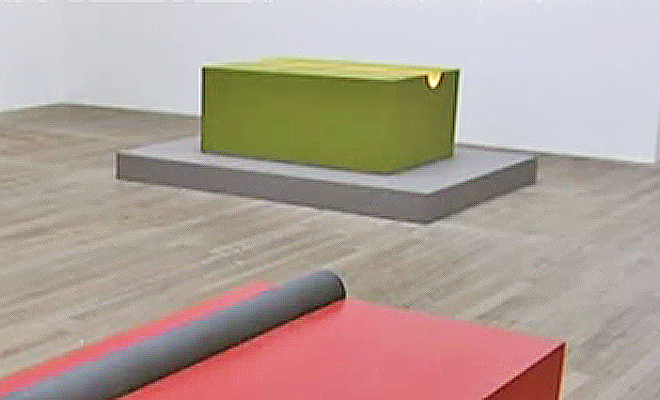
    This raises the question: What happens to this new aesthetic space when a museum places a piece by Donald Judd on a pedestal? The answer: the pedestal destroys it. Not until the incident at the Tate Modern nearly ten years ago, however, could we have seen how.

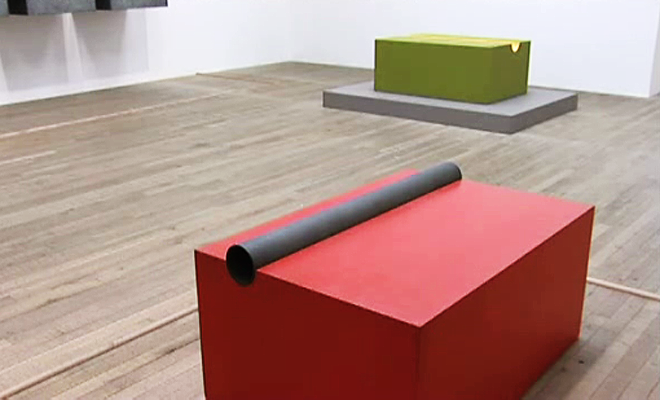
    In Untitled 1964 (RSS46 – see slide 1), what we see is space made solid. This will sound odd, since the very definition of space is the opposite of solid — as something non-solid. Nevertheless, the movement between opposites in Donald Judd’s art materialises space; it makes space a something rather than a nothing. As Donald Judd has written:

    [W]hat is needed is a created space, space made by someone, space that is formed as is a solid, the two the same, with the space and the solid defining each other. ((Donald Judd, ‘On Russian Art and Its Relation to My Work’, in ‘Complete Writings 1975-1986’, Van Abbemuseum, Eindhoven, 1987, p.17.))

    Untitled 1964 (RSS46) is a solid rectilinear volume with a non-solid semicircular trough running on top and to one side. Without the pedestal (see slide 3), it creates a spatial opposite, in reverse, above. As if by reflex, the non-solid semicircular trough becomes solid (see slide 4). This is not an illusion, but reason’s spontaneous movement harnessed by Donald Judd to materialise space.

    By placing Untitled 1964 (RSS46) on a pedestal, the spatial volume above disappears, as does the length of semicircular solid space that it defines. In its place, a surrounding space cloaks the artwork’s volume on all four sides, as defined by the pedestal (see slide 5). Albeit a space, it is not a space created by Donald Judd. It is not a space made solid through reason’s movement. It is a space to be looked through, not at.

    Seemingly frustrated by our inability to see the space he created, in a text printed posthumously Donald Judd wrote:

    There has been almost no discussion of space in art, nor in the present. The most important and developed aspect of present art is unknown. This concern, my main concern, has no history. There is no context; there are no terms; there are not any theories. There is only the visible work invisible. ((Donald Judd, ‘Some aspects of color in general and red and black in particular’, Artforum International. vol 32 n10 (Summer 1994). p. 70.))

    While much has changed due, in large, to writing by art historian Richard Shiff that concentrates on Donald Judd’s ‘space’, and while the passage by Donald Judd quoted above is reprinted in the Tate’s exhibition catalogue, it goes to show that still, today, this passage has not been quoted enough.

    (This is the final of a three part text, first published 13/06/2011.)

  • The art of noticing Part II

    The art of noticing Part II

    Often, it is not long before a sculpture student at tertiary level discovers their enthusiasm dinted by a definition of sculpture by the American painter Ad Reinhardt, as ‘something you bump into when you back up to look at a painting’.

    Just as often, though, the bad bruising quickly fades as one succeeds in one’s practice. Yet if for some strange reason one finds oneself reading an introduction to sculpture all over again, one cannot help but be hit by the definition once more, for being inevitably included.

    In Alex Potts’ introduction to ‘The Sculptural Imagination: Figurative, Modernist, Minimalist’ (2000, second printing 2009), however, there is a difference. The definition, here, is contextualised in a manner that leads us to understand it is not the entire genre of ‘sculpture’ that is being referred to, but to sculpture without any ‘clearly defined status’ as a depiction or representation; without, that is to say, any signposts that say ‘this is art’. It refers to sculpture without a pedestal, sculpture placed directly on the floor — sculpture bumped into for not being seen; or, at least, for not being seen as art.

    This invisibility is most likely part of the issue that raised its incommodious head in 2004 when a Donald Judd piece was exhibited on a pedestal at the Tate Modern.

    The incident spurred a conference last April at the University of Oregon, Portland, entitled ‘Donald Judd: Delegated Fabrication – history, practices, issues and implications’: the motor, it would seem, behind upcoming symposiums in New York and Berlin. An insightful introductory text by Arcy Douglass for the conference, begins by asking ‘What do you see when you look at a work by Judd?’. The text replies:

    One of the first things you might notice is that the work sits directly on the floor or directly to the wall. The work does not have pedestal or a frame. It shares the same space with you. There is nothing to separate you from the work.

    To notice the placement of Donald Judd’s art is key to unlocking its spatial drama. If overlooked, the reality of Ad Reinhardt’s maxim sets in. As a result, a common complaint is that, in not being able to see this art for oneself, unless one accidently backs into it one has to be pushed into it by art theory if one is to see anything at all.

    We can read this in an articulate online comment left by Ananya Mukherjee of New Delhi on 25 Feb 2011, to The Art Newspaper’s article Is Donald Judd’s art being wrongly handled?:

    This is the kind of work that, in the name of being democratic, actually pushes art deeper into the ways and politics of the art world, making the work and its meaning severely inaccessible. It is not possible to see Judd’s work without a reasonable sense of history to which it belongs — this might be true for all art but Judd makes it impossible to see anything outside of the context of its production.

    Yet even with ‘a reasonable sense of art history’, a viewer will still miss the key that gives access to this art for reasons much more, I regret, mundane. They are the same reasons why, at this very moment — while most likely sitting at your computer reading this text — you are absorbed in a space other than the space you physically inhabit.

    This is not said critically, but admirably. For this is the wondrous thing about thought. It bridges the physical and spatial barrier between oneself and another by allowing one to go, through thought, beyond oneself.

    As a consequence, however, one can become ‘thoughtless’ of one’s most immediate environment. Habit nevertheless looks after us during such thoughtlessness. Habit allows us to sit on the chair we are presently sitting on without us having to think through its function first. We did this, once, at some earlier age. Habit is acquired skill. Without its assistance, our thoughts would be consumed with every sip we take of our coffee, as though we had to learn to sip for the first time, every time. Yet, in allowing our thoughts to be elsewhere, habit blinds us to the ‘here’ of where we are.

    Since habit allows us to negotiate the objects in a room when we pass from one side to the other without having to think of them, it is not surprising, then, that we do not notice if one of these objects — similarly placed directly on the floor — is a work of art. The story  is different, though, if the object is established as meaningful by being raised to symbolic heights on a pedestal.

    The first to struggle against habitual blindness to see this art was Donald Judd. The placement of his first work directly on the floor in 1962 was not the result of a calculated intention in response to aesthetic politics and manoeuvres of the day. It was, instead — somewhat ingloriously — an accident: unpremeditated.

    Yet in seeing DSS 32 directly on the floor Donald Judd, it seems, was struck by this same struggle to see it — as are we. In a response to an interview question by John Coplan in 1971, he explains:

    I was surprised when I made those fist two free-standing pieces, to have something set out into the middle of the room. It puzzled me. On the one hand, I didn’t quite know what to make of it, and on the other, they suddenly seemed to have an enormous number of possibilities. ((John Coplans, ‘Don Judd’, for the Pasadena Art Museum, printed by the Castle Press, Pasadena, 1971, p. 30.))

    By recognising, in this struggle, an aesthetic space not seen in art before — a real space not segregated from the space we walk through, daily, while segregated, at the same time, as art — Donald Judd found something worth noticing.

    To break the habit of not seeing is to notice what we overlook when we seek established meaning. The art of noticing allows us not only to be absorbed in the real but find, in its struggle, unestablished meaning we are left to establish — if we believe in the empowerment of art.

    NB: This is a reposting of the second of a three part text, the subsequent parts of which will follow during the next couple of weeks.

  • The art of noticing Part I

    The art of noticing Part I

    The art of illusion is, for many, art per se. Through it, our unconscious absorption into representational imagery transports us somewhere other that the reality in which we stand. This remains the desired effect we request from art.

    Since the beginning of the previous century, however, various artists and art movements have endeavoured to shatter the unconsciousness of this absorption, (cubism, constructivism, Piet Mondrian, de Stijl, Jackson Pollock, minimalism), so we might take note of the ‘here and now’ to empower our presence.

    Yet the pull of absorption prevails as many of us by the end the century, find ourselves increasingly pulled into the internet’s various virtual galaxies. Within them, one can not only find friends and foes but even create an illusion of oneself as well as speak with impunity through anonymity.  The art of illusion has become the art of the everyday as we are more deeply drawn into the computer’s picture frame until knock-off time. Then we retire home to be unconsciously absorbed, some more, in television.

    As a consequence, absorption into a space other than the one in which our feet carry our weight, has taken hold at a scale far beyond yesterday’s celebrated artworks of illusion. It is against the magnetism of this pull that one might wonder what the art of non-illusion — of non-representational art — has to offer.

    The ‘here and now’ is loaded with burdens: rent payments we cannot meet, school fees we have somehow to find and awkward social moments that never add up meaningfully as they do in movies. Compared to illusion, the ‘here and now’ fails to appeal.

    Compared to illusion non-illusion is, just, ‘non’ — it is nothing.

    It is this winning force of illusion’s symbolic space against the comparatively meaningless space of non-representation that we encounter when we read in a January report of The Art Newspaper this year, that issue is being taken with the placement of one of Donald Judd’s 1964 plywood pieces on a pedestal in the Tate Modern’s 2004 retrospective exhibition of his work. It appears the Tate Modern ‘elevated’ a non-representational piece by Donald Judd from the seemingly meaningless ground of the here and now to the symbolic space of illusion, by placing it on a pedestal. By this simple act one can argue the Museum forfeited its custodial role in having presented a work of art as its opposite.

    Peter Ballantine, a long-time fabricator of Donald Judd’s art, recognises in the report the curator was most likely acting on behest of the artwork’s lender. Nevertheless, he says the incident, ‘showed how things can go wrong when the artist is not there to defend or explain himself’.

    A symposium soon to take place in New York and Berlin will ask whether, in the words of Peter Ballantine, ‘there are more authentic or less authentic ways to deal with Judd’. Meanwhile, the situation offers us an opportunity to ponder many an overdue question concerning the value of non-representational art today. Over the next few sessions, it is this I hope to do.

    Before doing so, however, curious to discover which piece by Donald Judd was placed on a pedestal, I surveyed a number of informative videos of the exhibition the Tate Modern has posted on its site. In them, we see the Director of the Tate who is the curator of the exhibition, Nicholas Serota, eloquently ‘walk us’ through a number of the exhibited works. At one point, while discussing what appears to be Untitled 1963 (DSS39) in the foreground, we see in the background Untitled 1964 (DSS46) on a grey painted pedestal that looks to be about 15cm high (see the image above). It appears to be the only work treated this way, which strongly suggests the work’s elevation has a lot more to do with the lender of the work than being a preference of the curator.

    By the end I hope to present an alternative understanding non-representational art, today, other than the ‘nothing’ it has become in the face of illusion’s broad appeal. It is an alternative made present by Donald Judd’s art, an alternative we might fittingly describe as the ‘art of noticing’.

    NB: This is a reposting of the first of a three part text, the subsequent parts of which will follow during the next couple of weeks.