Tag: Exhibition: To Do

  • Exhibition: To Do performed as a musical score

    Exhibition: To Do performed as a musical score

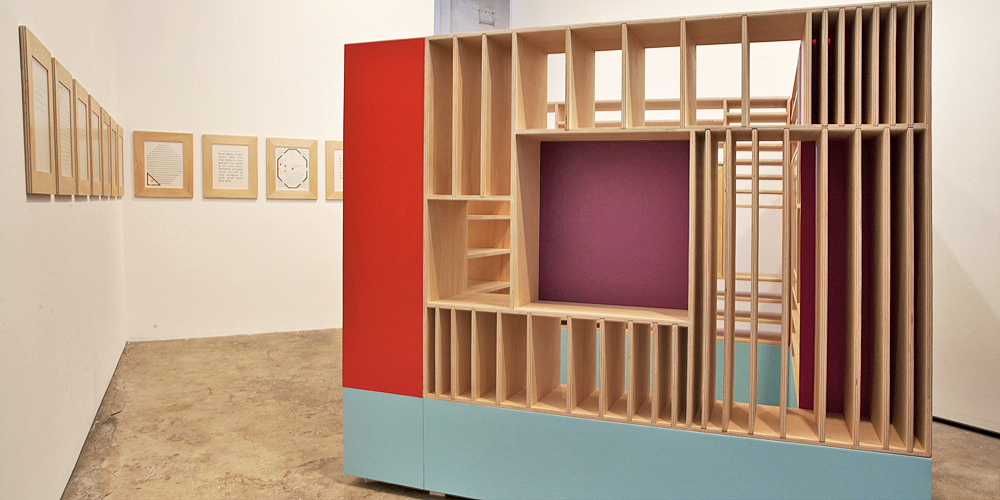
    Clarinetist Megan Clune ‘played’ Exhibition: To Do, 2014, on the last day of its exhibition at The Commercial gallery, Sydney. Exhibition: To Do can be played as a musical score given it is, ostensibly, a composition of spacial measures not unlike beats in a bar.

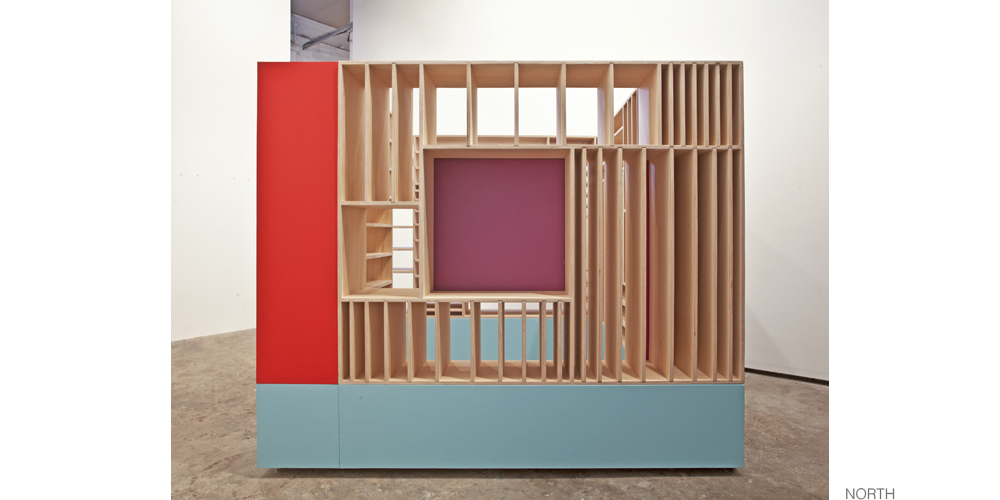
    The measured beats in Exhibition: To Do are punctuated by wooden uprights that separate each storage space.

    The uprights act much like bars in musical notation that contain within them a group of counts.

    Here, though, rather than a time signature such as 3/4 determining a consistent measure throughout, the number of beats is instead determined by the actual measurement of space of each shelf. In this way, each bar separates a physical space played as a musical note.

    The pitch of the note is not determined—just its timing.

    While this might sound random, it isn’t. The width, breadth and depth of the shelves that comprise Exhibition: To Do are measured in multiples of 18.

    For instance, 103 lots of 18 equals the height of Exhibition: To Do at 1854mm; whereas 125 lots of 18 equals its breadth at 2250mm.

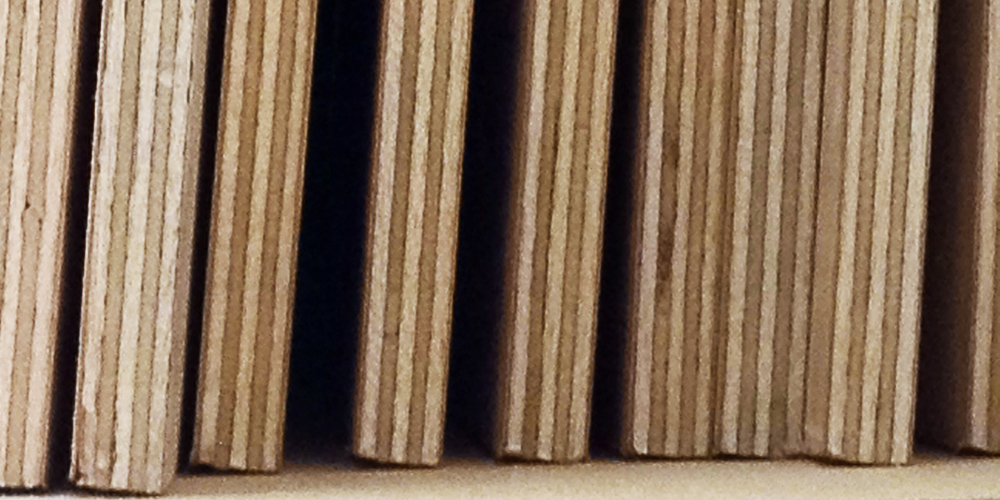
    Eighteen millimetres is the thickness of plywood used to build the shelves.((See artists’ notes in the art index listing for Exhibition: To Do for more in-depth details on this.))

    Accordingly, each wooden upright—or bar—is 18mm and the space between two bars is a multiple of 18. The multiple is, as a result, the count for which one holds the note. If the space between two bars is four lots of 18 (i.e. 4 x 18 = 72mm), then the note is held for four counts while the bar, itself, is held as a pause of one count.

    Starting from the left of the West wall, Megan progressively read the count of space between bars, clockwise, then moved on to the next storage unit until the outside and inside of Exhibition: To Do had been entirely played.

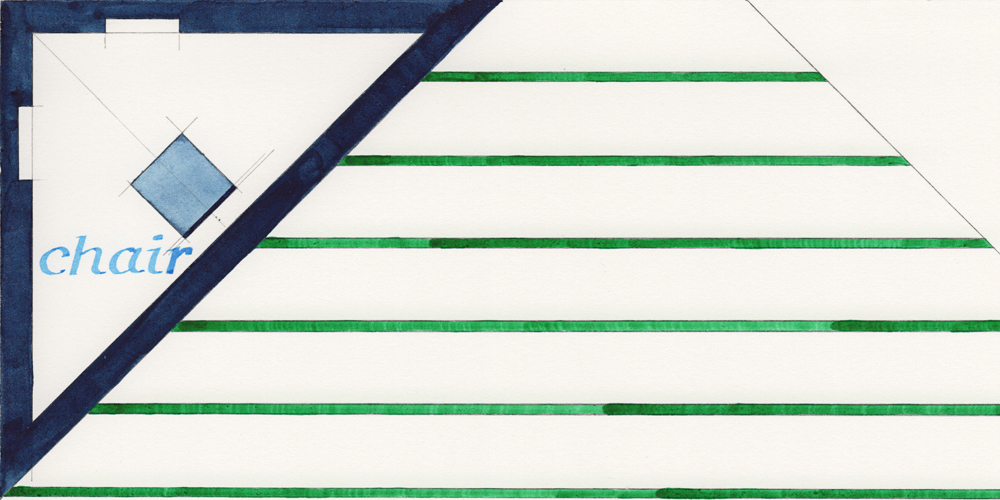
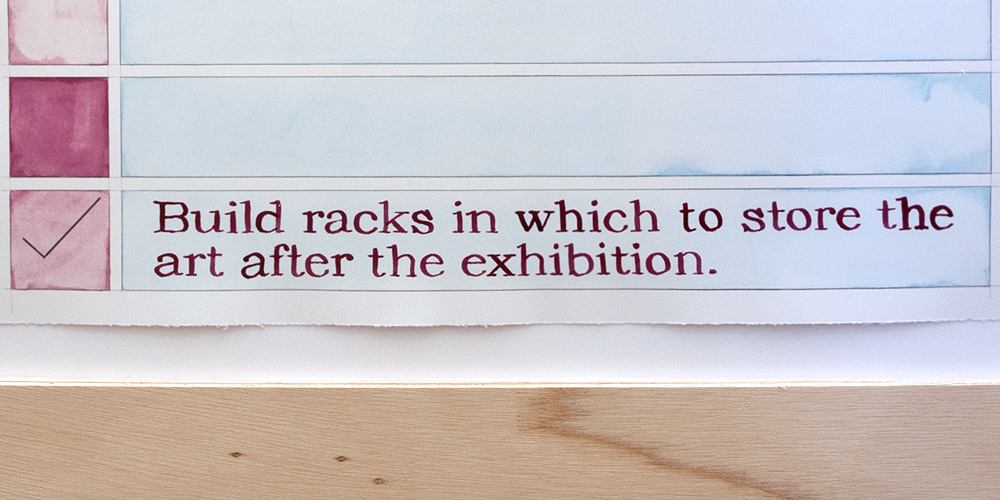
    Exhibition To Do13Exhibition: To Do, in being a composition of space, is also a ‘To Do’ list compiled to complete an exhibition of art. The last of five items on the list reads: ‘Build racks in which to store the art after the exhibition’.

    Any artist preparing for an exhibition would find this last item self-defeating. To include the list item means, in short, one little expects a strong enough response to the work.

    The list item suggests preparations to care for the art, no matter its reception. Art may have to undergo a storage shelf’s deep sleep to survive the duration a public takes to wake to it.

    In reality, though, artists can ill afford perpetuity’s storage and are unlikely to include it as a preparatory action in the process of making art. To do otherwise can’t help but promote a lack of the art’s reception as a fait accompli.

    In Exhibition: To Do, the list item ‘Make the art for an upcoming exhibition’ is not ticked, it remains undone. Exhibition: To Do exists as an awaiting space for art yet to be made; a placeholder for art’s promise—its assurance, its declaration, its belief.

    It is the same promise that can overwhelm art students as they forge against preconceptions and shed security to make art. The promise of art drives, it directs; it gets an artist out of bed and into the studio when there is no money with which to eat and pay the rent. It is the same promise against which a student’s resulting artwork is compared and often found to be lacking—where the plans for art hold more potential than their manifested, material reality. Every artist is forever art’s student.

    Rather than a tool used with which to make art; in Exhibition: To Do art’s promise is the ‘thing’—the object—exhibited on the shelves.

    Usually negated as a nothing of art, it was with extraordinary relief that I heard this promise bellow—its lament, its protest, its resistance, its resolve—when Megan Clune’s clarinet sounded it as a breath-filled, wood-tunnelled number of counts.
  • Review of Exhibition: To Do in Art Monthly

    Review of Exhibition: To Do in Art Monthly

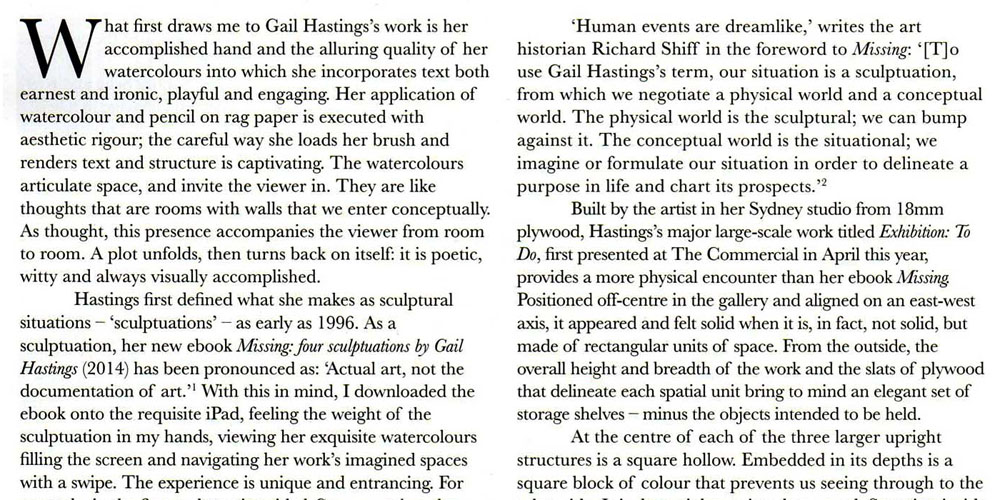
    In the August 2014 edition of Art Monthly Australia there is a review of Exhibition: To Do (2014) and Missing: four sculptuations by Gail Hastings (2014), by Judith Blackall. The Library now holds the article,  Gail Hastings: Sculptuations.

  • Announcement: Gail Hastings’ Exhibition: To Do performed as a score | at The Commercial | Saturday 4-6pm

    Announcement: Gail Hastings’ Exhibition: To Do performed as a score | at The Commercial | Saturday 4-6pm

    Image: Gail Hastings, Exhibition: To Do, 2014, acrylic on plywood, plywood, watercolour and lead pencil on paper, 185.4 x 225 x 225cm (photo: Sofia Freeman)

    Exhibition: To Do

    Closing Launch: Saturday 3 May, 4-6pm

    with the work’s spatial score performed by clarinetist

    Megan Clune

    starting 4:45pm

    open Wednesday-Saturday, 11am-6pm
    148 Abercrombie Street, Redfern, NSW, Australia, +61 2 8096 3292


    Gail Hastings’ Exhibition: To Do is a ‘to-do list’ for making art not yet done, a task-at-hand still at-hand, except for the construction of storage shelves that await the art, aligned in the gallery along the Earth’s cardinal axes.

    The height, width and depth of each of the four storage shelves that comprise Exhibition: To Do have been determined by the thickness of the plywood used (18mm) and the repeatable pattern of spaces this thickness makes.  ‘The ubiquitous need to create space for a desired event through a ‘to-do’ list in which a disarray of tasks can be put into productive order’ forms, here, a composition of solid and non-solid intervals that implicate a spatial weft and warp of patience and breath.

    Clarinetist Megan Clune will perform Exhibition: To Do‘s score of spatial intervals. (more…)

  • Review of ‘Exhibition: To Do’ by Chloé Wolifson

    Review of ‘Exhibition: To Do’ by Chloé Wolifson

    A review of Exhibition: To Do by Chloé Wolifson can be found on the Arts Hub, Saturday 19 April 2014.

    Delicately rendered in watercolour with ruled pencil lines emerging from the edges of the translucent wash, these pieces depict the To Do list in question. One such reminder, the instruction: ‘Build racks in which to store the art after the exhibition’, speaks volumes about the established systems of the art world, and the particular approach artists must take when they create work which sits outside the conventionally commercial.

    Cholé Wolifson, 19 April 2014.

    Corner caretakers, 2014, one of the four sculptuations in the ebook Missing purchased through iBooks, is also mentioned.

  • ‘Corner caretakers’ and ‘Space of a five page plot’ now on view at The Commercial

    ‘Corner caretakers’ and ‘Space of a five page plot’ now on view at The Commercial

    Corner caretakers, 2014, and Space of a five page plot, 2014, are two of four sculptuations that comprise the ebook Missing: four sculptuations by Gail Hastings, 2014 available at iBooks. Both are now on view at The Commercial Gallery, Redfern, along with the sculptuation Exhibition: To Do, 2014.

  • Announcement: Exhibition: To Do

    Announcement: Exhibition: To Do

    The Commercial

    Images 1-4 Gail Hastings, Exhibition: To Do, 2014, acrylic on plywood, plywood, watercolour and lead pencil on paper, 185.5 x 225 x 225cm; image 5 exhibition installation view; images 6-7 Gail Hastings,Corner caretakers, 2014, watercolour and lead pencil on paper in plywood frames, 12 components, each 55 x 46.5 x 1.8cm (Corner caretakers is a sculptuation from Gail Hastings’ eBook, Missing, 2014)

    The four walls that make up Gail Hastings’ Exhibition: To Do are oriented within the gallery along the Earth’s axis — coordinates and a rudimentary geometry shared by all. Each wall bears geometric patterns of shelves — small units of space — made of intervals and intersections described and located along xy and z axes. The pattern of spatial intervals has been determined by the material thickness of the wood used — 18mm; wherein solidity and space play interchanging parts (e.g. solid, space, space, solid, space, space, solid, space, space, solid …) along the height and length of each object. In these ways, Hastings has eliminated extraneous moments of decision-making, lending a sense of givenness to the exhibition but also its need to be made. […]

    (more…)

  • Exhibition: To Do

    Exhibition: To Do

    Gail Hastings’ forthcoming exhibition is entitled Exhibition: To Do and will open at The Commercial on Friday, 11 April 2014, 6-8pm.

    An excerpt from the exhibition record reads:

    Space is generally thought of in its ideal form — as empty. Notions, such as needing space to breath, space to move, space to be free and outer space (uninhabited) point this way. In being empty, space is thought of as missing something, something that can fill it. It is why space is spoken of with such potential.

    The conundrum, then, is how does one retain this potential when one makes art that creates space — an aesthetic space that is not missing something but is, instead, a something: a concrete thing?

    Some time ago I was in a cafe in Melbourne, in St Kilda, enjoying a cup of coffee when I could not help but overhear two conversations on art taking place on either side of me. . .