Tag: Habit’s pattern

  • Sculptuation by Gail Hastings in 20/200 at Sarah Cottier Gallery opening next Thursday, 13 March

    Sculptuation by Gail Hastings in 20/200 at Sarah Cottier Gallery opening next Thursday, 13 March

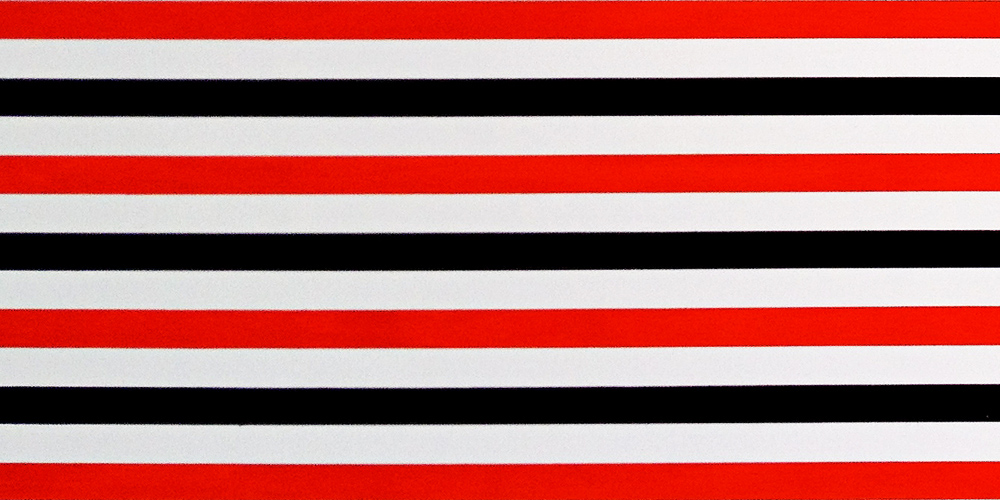
    20/200 is  group exhibition at Sarah Cottier Gallery that marks 20 years and over 200 exhibitions for the gallery. Gail Hastings is delighted to contribute a sculptuation to the exhibition for having participated in the 1996 exhibition ‘Road to Love’ (20.03.1996–30.03.1996) curated by Mikala Dwyer. The gallery, then, was located at 36 Lennox Street, Newtown, Sydney. The two sculptuations by Gail Hastings included in the 1996 exhibition were untitled 1995 (four pages from the Encyclopaedia of Words), 1995 (private collection, Brisbane) and To make a work of forgetful art, 1996 (private collection, Brisbane). More on 20/200 can be found in the 20/200 exhibition record and the Sarah Cottier Gallery website. (photo: habit’s pattern: orange and black, 2010)


  • A note on ‘Leave the line standing’

    A note on ‘Leave the line standing’

    We were squabbling over how best to cut the piece of wood when, with jigsaw in hand, I decided to ignore Mick and get on with the job as I always do — uncomfortable with and annoyed by his audience. Then Mick made a last ditched effort and said, ‘leave the line standing’. Standing? Line?

    Mick is the elderly, long time caretaker at St Canice’s parish, Kings Cross. Our conversation took place in the annex where I was working.

    I put down the jigsaw, baffled. He explained: ‘You either cut the line off or leave the line standing’. With this I realised there was in fact ‘no line’ between us, we had been saying the same thing just differently, without realising: all that polite frustration with another, for nothing.

    When, months later, I came to exhibit my art in the same room, this line seemed the right type of line to leave standing.

    For Mick initiated me to a phrase that meant my struggle with ‘the line’ was shared by the legion of carpenters who had coined it. The phrase also spoke of a type of art in which ‘the line’ can often cause an artist considerable dilemma.

    We are not speaking, here, of a line one pixel thick as regularly seen on a computer screen, but a line drawn with a lead pencil that is blunt, no matter how often it is sharpened, given the wood grain over which it is drawn. A line one millimetre thick (just sharpened), is a one millimetre difference between a piece of wood fitting within a construction, or not. It is a line that can prove the bane of many a woodworking day.

    Generally, we think of a line as the shortest distance between two points. Spatially, it differentiates the area it divides into two. In reality, however, a line — in itself — is also an area. The number of spaces, therefore, a line differentiates is not two (left-side/right-side), but three when we factor in the actual space of the line, a factor that, if ignored, can waste half a day and a good piece of wood.

    The space of this line — its medium, its thickness, its history, its lack of transparency, its own problems — is a line mostly ignored, however, when people use it to carve up an issue whether it be in politics or on the home front. Once the issue has been cleaved in two, the line is usually rubbed out along with any trace of fickleness with which it ruled the situation. As a general practice of society, it often becomes a default frame of mind with which we approach many things.

    This is made evident in many a student’s first drawing classes that often necessitates a complete mental re-wiring during the first months at art college. One teacher in particular banned the rubber from class, which meant we had to live with the mess of mistakes otherwise called a drawing — a mishmash of inopportune delineations that blighted all recognition of the thing drawn.

    These first results couldn’t help but scar one’s sense of achievement until, over time, one became drawn into the force of the lines, themselves, and the lively power of congestion around difficult areas re-drawn, over and again, to get right. Rightness, in the end, no longer mattered compared with a lines’ honest witness to that moment, its independent corroboration and antidote to denial.

    My art retains these lines still, today. Whether working on a watercolour or pencilling in the stripes for a painting — I never rub out the lines. When imaginatively walking within a water-colour floor plan, one cannot help but trip over these lines. It is perhaps why it has been suggested I remove the lines that are thought to undermine a sense of the work’s perfection. The lines, however,  witness the work.

    For this reason it was a delight to hear Mick say  ‘leave the line standing’. It was a line in a conversation with a big enough dimension to become the space for an exhibition.

  • On the habit of spatial shifts

    Habit is something we are unable to live without. If the many menial tasks we complete each day were not a matter of habit, they would absorb all the attention we have for other more important things.

    Habit allows us to add a couple of spoonfuls of sugar to our tea, without having to register the various tasks necessary to do so.  We can be mindless of the way our thumb is variously positioned on the stem of the spoon when it balances the spoon at one moment, tilts it the next, then applies enough pressure to dig into the sugar and secure enough to then tilt the sugar into our cup — all before we stir our tea, let alone sip it. If we were to think through each step as though never before performed, the tea would be cold before it reached our lips.

    Habit has benefits.

    At what point, though, does habit tip from helping us to achieve more in our day, to blinding us from seeing what, exactly, is in our day?

    Habit frees attention by following a perceptual pattern that enables us to do an increasing number of things by blinding us to others. While this is intrinsic to a functioning daily life habit, nevertheless, turns art that activates a paradigm shift — art that invites us to see that which our patterned perceptions inhibit us to see — into art that remains unseen and unrecognised for years.

    At this point it might seem odd to cite Minimal art as an example, given it has been around since the 1960s. Yet why is it that those who pour over its imagery in books out of respect for art history, remain blind to recognising for themselves Minimal art’s tenets when experienced in real life?

    This would have to be a major mystery confined not only to contemporary art. If the mystery was a floor plan of an enclosed space that we see from above, because it is seen from above, we are able to make correlations between objects inside and outside the space. Our overview enables us to see, for instance, that a blue shape outside the space is the same blue inside the space.

    At ground level, however, we are unable to make this correlation since we are without the perceptive power of an overlooking single view. We are either inside the enclosed space or outside — not both at the same time. To compare the two instances of blue, we would have to see the first, remember and compare it to the second: a comparison afflicted by memory’s distortions.

    In other words, there is always a spatial shift between an overview of a subject (e.g. as knowledge gained through reading) and a grounded view’s actual experience of that subject.

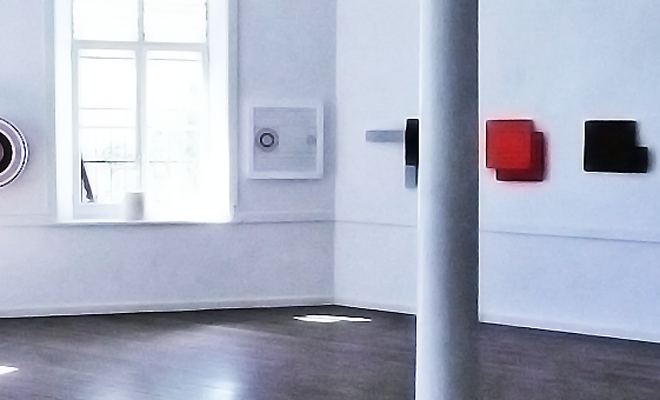
    In habit’s pattern: red and grey, we see a red and grey striped painting that is a ledge. A part of the pattern is missing. The missing part is found in the framed watercolour that rests on the ledge. When seen together, nothing of the pattern is missing, all the parts are accounted for — it is complete. Yet, within this completion, there is a spatial shift. A part of the red and grey striped pattern appears in one space, while the rest appears in another. The two spaces are, however, aligned — through the spatial shift. When we recognise this spatial shift, we forge a connection. Without recognition, the pattern remains disconnected, unrecognised, unseen.

    This spatial shift is repeated by the red and grey stripes within the painting we are outside of, while the missing stripes are present in the room within which we stand, as red and grey rugs, when we imaginatively enter the watercolour floor plan. This spatial shift involves a shift in scale. Those locked within the watercolour scenario would fail to correlate the two instances for reasons that constitute the very experience of our everyday. The sculptuation places us, on the other hand, in a position to see.

  • Why I make editions: A space for possibilities

    Why I make editions: A space for possibilities

    A ‘limited edition’ is a term we generally associate with printmaking or photography in contemporary art. Both involve the reproduction of an artwork a number of times. If the ‘number of times’ is limited to, say, 100 prints, then the artwork is an edition of 100.

    There is a problem here, however, with the word ‘reproduction’. For the word suggests it is an original artwork that is copied. The ‘original’, however, from which a contemporary print is pulled is not, in fact, an artwork but a block of wood, piece of lino or etched metal plate. While in photography, if digital, it is a raw image file of electronic signals turned into 0’s and 1’s.

    Technically speaking, then, each print is not a ‘copy’ of an artwork, but an artwork in itself. As ‘originality’ is one of the most persisting measures of a work of art, the question therefore arises as to how a contemporary print can be original and a reproduction at the same time.

    If originality rests on difference, we can find difference within printmaking by the fact a source degenerates, through wear and tear, each time a print is taken. As a result, each print is particular in its departure from the ‘whole’. If, however, its departure is too original, the print loses its value as part of a whole. Originality, as such, takes on certain parameters within which any shift too great breaks the context that defines it.

    The relation between the whole and its parts, the prints, is therefore interesting. In certain ways it is not unlike the relation between the ancient philosopher Plato’s pure forms — ideas — and the objects derived from them. A pure form, for instance, could be a bed. If we think of all the beds built throughout time, each and every bed is but a reproduction of the one true bed, the absolute bed, the idea of a bed.

    Yet this idea of a bed is not something we can actually pull back the covers of and sleep in. Its reproductions, however, as the concrete objects that populate our bedrooms, are.

    Similarly, although the abiding image of a contemporary print edition is reproduced by each print, it — as an object itself — does not exist.

    Accordingly, there cannot be two (or more) ideas of a bed, only one ideal bed from which others are derived. An original cannot be a copy at the same time. For ‘if there had been two’, writes Plato in The Republic, ‘there would always have been a third — more absolute and abstract than either, under which they would have been included’. The third, therefore, would be the original and the other two its copies.

    This, though, flies in the face of a contemporary print being an original as well as a copy. There is nevertheless still a similarity. An Ideal form is a whole that includes its reproductions, just as a print edition’s abiding image, the conglomerate of all that is common in each print, is a whole that includes each print’s similarities.

    This parallel between Plato’s pure forms and a limited edition is, however, an awkward one to make today. Any Platonic notion of a pure Idea or absolute Ideal has been permanently besmirched for any artist working on this side of minimalism.

    A non-material form we cannot physically experience (the idea of a bed) is no longer more ‘real’, as in Plato’s day, than a material object we can physically experience (a concrete bed). The real is no longer God given (Plato’s forms), but earth bound (minimalism’s objects). Experience no longer confounds understanding (Plato) but is its foundation (minimalism). Minimalism is the ‘art of the real’. ((The art of the real; USA, 1948-1968 was the title of the 1968 exhibition curated by E.C. Goossen that included works by the minimalists and which travelled to Europe.))

    Post modernism, of course, took anti-Platonism further to obliterate the ‘pure’ entirely.  In this way ‘particularity’, in all its cultural, social, sexual and technological difference, is here to stay. Difference is defiance. Under such sway, the ‘whole’ is secularised blasphemy.

    This, for me at least, is a problem. I consider the ‘whole’ — albeit generally unrecognised — integral to minimalism, and I love minimalism. With everyone busy burning the ‘pure’ to much applause, no one appears to realise they have used the ‘whole’ as kindle. No art history lecture or essay have identified this. It has been a problem without words for me, for so long. Until, that is, I began to make editions.

    The first edition I made was during a six-month Power Institute studio residency at the Cité Internationale des Arts, Paris, in 1995. Not that I thought of or called the art I subsequently made an edition at the time. It was, rather, a nameless urge inspired by a purchase I made from the lower floor hardware section of the Bazar de l’Hôtel de Ville department store.

    The Bazar de l’Hôtel de Ville, as some will recall, is where in 1914 Marcel Duchamp purchased the first ‘unassisted’ readymade – the Bottle Rack (1914). ((See Thierry de Duve, ‘Kant after Duchamp’, An October Book, The MIT Press, p. 250.))

    Now treated with the conservator’s white gloves of art history as one of its most precious contemporary art objects, at the time this first unassisted readymade was unceremoniously dumped in the rubbish by Marcel Duchamp’s sister when tasked with clearing his studio after his departure for New York. Not until 1921 was a replacement purchased. ((See the National Gallery of Australia‘s notes. ))

    With this we have another parallel with a Platonic pure form. While many replicas have since ensured this first unassisted readymade retains its place in history, we only know this bottle rack through its replicas since it, itself, like a pure form, does not materially exist. ((Based on notes from the National Gallery of Australia‘s website, in 1921 Marcel Duchamp purchased a replacement (collection: Robert Lebel, Paris); in 1945 Man Ray purchased a third replica; in 1960 Robert Rauschenberg purchased a fourth replica in New York; and in 1963 a fifth was made for the Moderna Museet, Stockholm. In addition to which, in 1964, an edition of eight was made by Galleria Schwarz, Milan — of which the National Gallery of Australia has one. See picture.))

    It was not this, admittedly, that had me repeatedly traipse up Rue de Rivoli to ransack the basement floor of the Bazar de l’Hôtel de Ville to see, embarrassing as it is to admit, if they might perchance still sell the same bottle rack. They do not. Yet, in seeking it, I was captivated by how Duchamp’s 1914 bottle rack was but one of an unintentional limited edition. Each bottle rack was a reproduction of an Ideal bottle rack, the bottle rack each customer thought they had purchased before they discovered the idiosyncrasies, the faults, the particularities, of the one they actually purchased. Having signed an idiosyncratically ridden bottle rack, Marcel Duchamp effectively replaced the ‘Ideal’ in art that is pure and original, with a ‘particular’ that is impure and banal. He replaced the ‘whole’ with a ‘part’.

    If only I could make the same retrospectively inspired, though at the time ‘disinterested’, purchase. I tried, but failed.

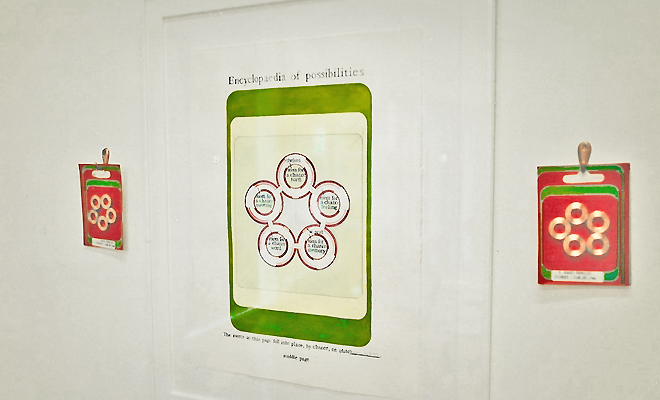
    No matter on how many days I searched the basement, I had finally to realise I was no Marcel Duchamp (how arrogant, I know, to have even presumed otherwise). I accepted failure, then found something. Not a readymade, but a vacuum pack of brass circles arrayed in a geometric flower pattern, on a hot magenta and lime green board.

    Each pack of five rings reproduces the same pattern, differently. Each represents a possibility within a certain set of circumstances that delimit a whole space. I bought quite a few packs, took them back to the Power studio at the Cité and made the same work over and over — enamoured by a ‘whole’ from which each possibility derived.

    I took these with me to Düsseldorf, as I was about to have an exhibition there. The gallery director — Thomas Taubert — suggested we sell them as a limited edition. ((Encyclopaedia of possibilities, 1995, a limited edition of three, each of three parts, was exhibited in To make a work of thoughtful art, Ausstellungsraum Thomas Taubert, Düsseldorf, in 1995.)) I have made numerous editions since.