Category: catalogue

  • empirical vision

    Whoever glances first at this post will be the only other person than me for all these years, to see my forensic measurements of silence filling my Los Angeles studio residency between phone calls in 1996. Before, that is, the next person who sees the post.

    Compared to the socially astute and declarative character of artists these days in Melbourne, my studio processes can’t help but seem archaic. Did I think I was some undercover spy recording the cryptic vacancy of inert matter before the phone’s shrill call for action dispelled everything? Should I be embarrassed? Agent Anon decoding silence into meaningful information to help win the next, as yet, undeclared war? Such whimsical jinks wouldn’t have kept me at it for page after page (after page). Yet here I speak as though outside this moment, casting it off as yesterday’s delusion. When I am still inside its earnestness, adding to its pages day after day, giving a substantial existence to space.

    Re-reading Bernard Smith’s European Vision and the South Pacific gives me another strange parallel. Swimming through the pleasure of Smith’s insights, held buoyant by the previously unexplored history they yield, I began comparing my investigative note-taking to the newly developed empirical observation and scientific rigour that exploring the Pacific opened for artists of the late 1770s. Smith writes: ‘In consequence, their mode of perception became increasingly less dominated by neo-classical theories of art and increasingly more influenced by empirical habits of vision’. Is my studio process but a centuries-old by-product of the region’s empirical breach with European expressive naturalism?

    This page of silence-evidence in particular measures a 12 hour and 49 minute silence between Thursday 25 July at 9:41 pm and Friday 26 July at 10:30 am that equates to a 38.45 cm length of space — the length of space in the green space holder in a silent corner 2, exhibited in Munich in 1997, and the silence turned into substance on the opposite fold of the corner. 

  • Why epic space?

    Earlier, I neglected to say what led me to make space complex by making epic space.

    In an art college art history lecture some twenty years or more after its emergence in North America, I first learned about Minimal art. I was struggling at art college at the time, unable to see the point of making art in a society in pain and requiring attention by trained professionals. Making art, in comparison, seemed like a luxurious lifestyle choice albeit its poverty, one I was disinterested in. 

    When, however, I learned of Minimal art in the art history lecture, my life changed. Immediately, I could see purpose in becoming an artist. Visual art could play an active role in building better life-paths for others.

    Unfortunately, though, Minimal art’s very name let it down. It describes the reduction and simplicity with which commentators treated it. The coinage conceals the 3D work’s spatial complexity when it is this complexity that led me to devote my practice to the development of non-a priori space in art.

    In Berlin, in 1998, with a need to draw attention to the complexity of non-a priori space, I made ‘art idea no. 8,582,048’.  

    As part of the three semiospheres the work comprises, the image above shows four alternate centres for the idea’s lost centre. 

    A part of the accompanying watercolour reads: The authorities therefore searched for the idea’s missing centre and, in so doing, found four possibilities. The question thus arose: which of the four is the missing one? We, a handful of willing viewers, were asked to decide. The decision, however, has not yet been made for ‘viewers’ are not to touch the art and as the idea is in the other room, we can only compare it to the possibilities via memory. This process is laborious and up until this hour [12.09 Uhr] of this day  [Mittwoch 18.11.1998] , our memories have failed.

  • Epic space

    Epic space — is how I would now describe art idea no. 8,582,048 that I made during a Berlin residency at Künstlerhaus Bethanien in 1998-9. 

    As far as I know, epic space does not exist in visual art. At least, not in three-dimensional work. A depiction might be of an epic scene, but not itself epic. Though this leads to questions of the episodic, so I’ll leave off with etymology before I negate epic space.

    The Odyssey is an epic poem by Homer from the late eighth-century BCE. It spans Odysseus’ seven-year homeward journey from triumph in Troy to redemption in his hometown of Ithaca. It traverses countless adventures in between that occur within a framework of these two places.

    Unlike The Odyssey, art idea no. 8,582,048 doesn’t take place within a pre-destined beginning and end. However, just like The Odyssey, the work’s separate situations balloon around each other to find their cause, their beginning, outside their immediate situation to no end.

    Take, for example, something in our own lives — a letter sent through the post now resting on a table. Its immediate situation involves our direct attention in the room in which we read it. The letter connects, however, to another situation outside our room. An office has sent it, say, if it’s a bill. The envelope links the two disparate situations. To borrow a term from the semiotician Juri Lotman, each of these two situations is a self-determined semiosphere. 

    Art idea no. 8,582,048 interlaces three such semiospheres within its bounds. Each begins off-stage with an exhibition invitation gallery recipients open in the privacy of their homes (a poster pictured above). A self-supporting artwork with curved corners and green, orange and blue pattern, is perpendicular to ‘desk no. 5’ with a photocopy of a Russian constructivist in the background.

    In a subsequent semiosphere, we discover this is the Bureau of Art Ideas, Berlin. The artwork, evidently registered, is art idea no. 8,582,048. Two critics, nevertheless, have pulled the artwork apart and lose its reason for being, its cause, its centre, in their arguments. The overall artwork is therefore caught at this moment: a choice between four replacement centres.

  • Encyclopaedia of Real Space

    Encyclopaedia of Real Space

    Encyclopaedia of Real Space

    She is alone this figure of hollow space known as the outside.
    Aether thin, shared as background: being’s realm — she is not alone.

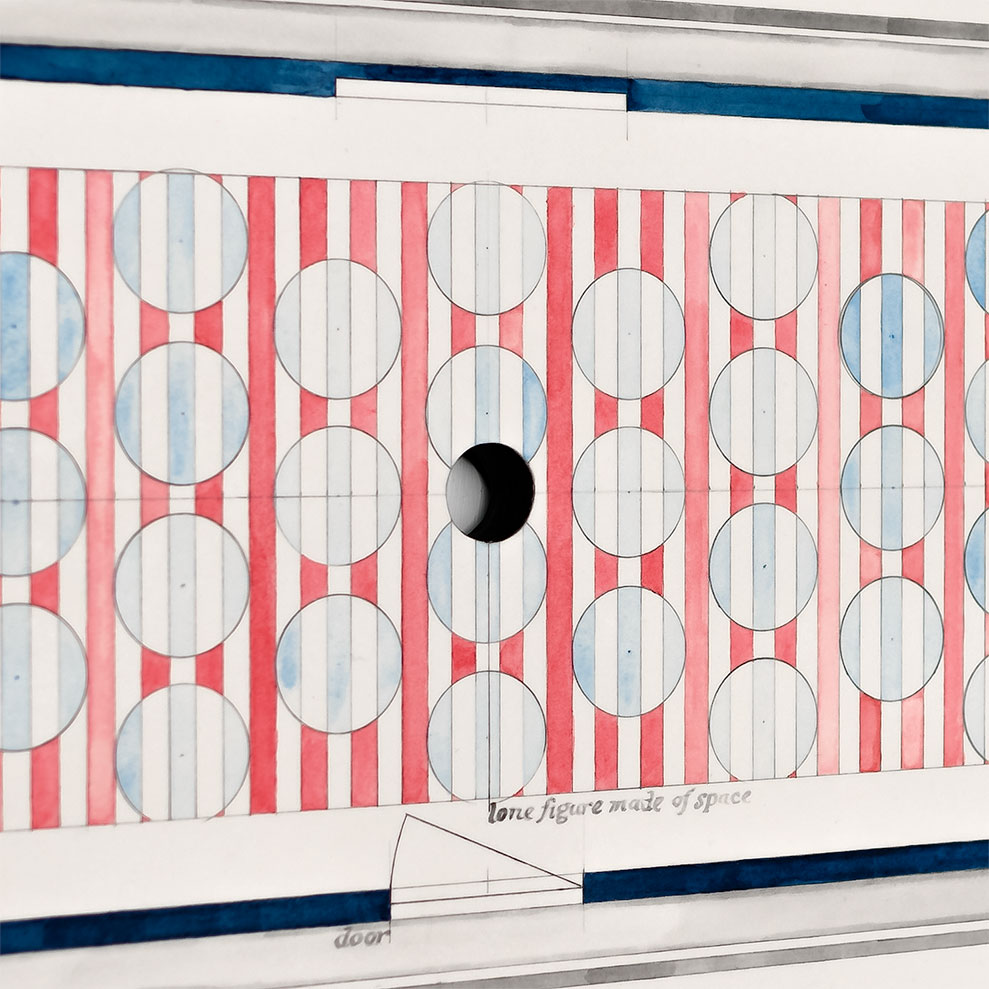
    Encyclopaedia of real space: one background, 2023
    watercolour and lead pencil on paper, varnish with UVLS on watercolour, acrylic on wood and actual space
    29.5 x 118 x 1.8 cm

    ————————

    Encyclopaedia of real space: one background is a self-portrait.

    It shifts between a central figure against a ground and the same figure as the ground. Actual space constitutes both figure and ground as one and the same. Yet within this sameness there shifts a movement between one extreme (as figure) and its opposite (as ground).

    Since the self-portrait’s figure is me, I am this movement between opposite extremes.

    Any psychologist reading this might wonder if I suffer what is called ‘dissociation’. Instead of associating with an image of myself with two eyes, a nose, a mouth and brown hair — an image someone might recognise in the street and to whom they yell ‘hi Gail’ — I associate with the space outside me. Instead of existing in a private enclave of self-certainty I know as me, I exist in an outside movement — through an encyclopaedia of real space.

    Dissociation is a chronic and debilitating state those who have suffered abuse might experience. I don’t doubt the condition’s severity.

    While I don’t have the grade to argue with any psychologist’s assessment of my self-depiction as dissociated — I do proffer an alternative or parallel understanding.

    For instance, we might also consider metamorphosis as the change one undergoes when engaging in cultural exchange. To follow the steps of a character in a novel, for instance, a reader unwittingly transfigures into that character to appreciate the character’s encounters, all the while maintaining a sense of self to which the reader safely returns. The movement in one direction, then retracts in the other.

    Where, then, might one draw the line between this ancient realm of metamorphosis and its assessment, today, as dissociation?

    The artwork’s text in the Encyclopaedia of real space follows the form of an elegiac couplet in which the ancient poet Ovid was most adept. Enamoured by the couplet’s structure, it seems to me to follow a metamorphic passage in itself. 

    The couplet’s metre includes a six-foot line followed by a five-foot line in a repetitive long, short, short beat. You can find an avid exploration of Ovid’s elegiac couplets in Literature and History (dot com) that I’ve only somewhat belatedly discovered.

    Ovid describes the structure when he writes (as translated):
    While six feet rise and five pronounce my clear decline
    In elegiacs. Farewell, epic line.

    The first line inclines, the second line then declines. The first line begins its movement towards a turning point from which the second line returns. The forward then backward progression is the same metamorphic movement one encounters simply reading or engaging in cultural exchange.

    In the Encyclopaedia of real space, the elegiac couplet follows a long-short-short (dactyl) metre for a six-count outward movement followed by a five-count dactyl return with a break, a caesura, in the return’s middle:

    —— – – | —— – – | —— – – | —— —  | —— – – | —— —  

    —— – – | —— – – | —— | br | —— – – | —— – – | ——  (albeit fudged)

    Otherwise characterised as dissociation, Encyclopaedia of real space circumscribes thought’s outward and return movement beyond its biological limit — our skin.

    Encyclopaedia of real space: one background is a post-Kantian self-portrait. There aren’t many.

    Gail Hastings
    12 May 2023

    NB: Reference to a psychological assessment concerns conversations with professionals in that field after a bike accident I suffered at the beginning of the year. Whiling away minutes describing my work, its importance and how it works instead of describing me, I met the thorny issue of dissociation. It was a shock to realise my work fits that pattern.